



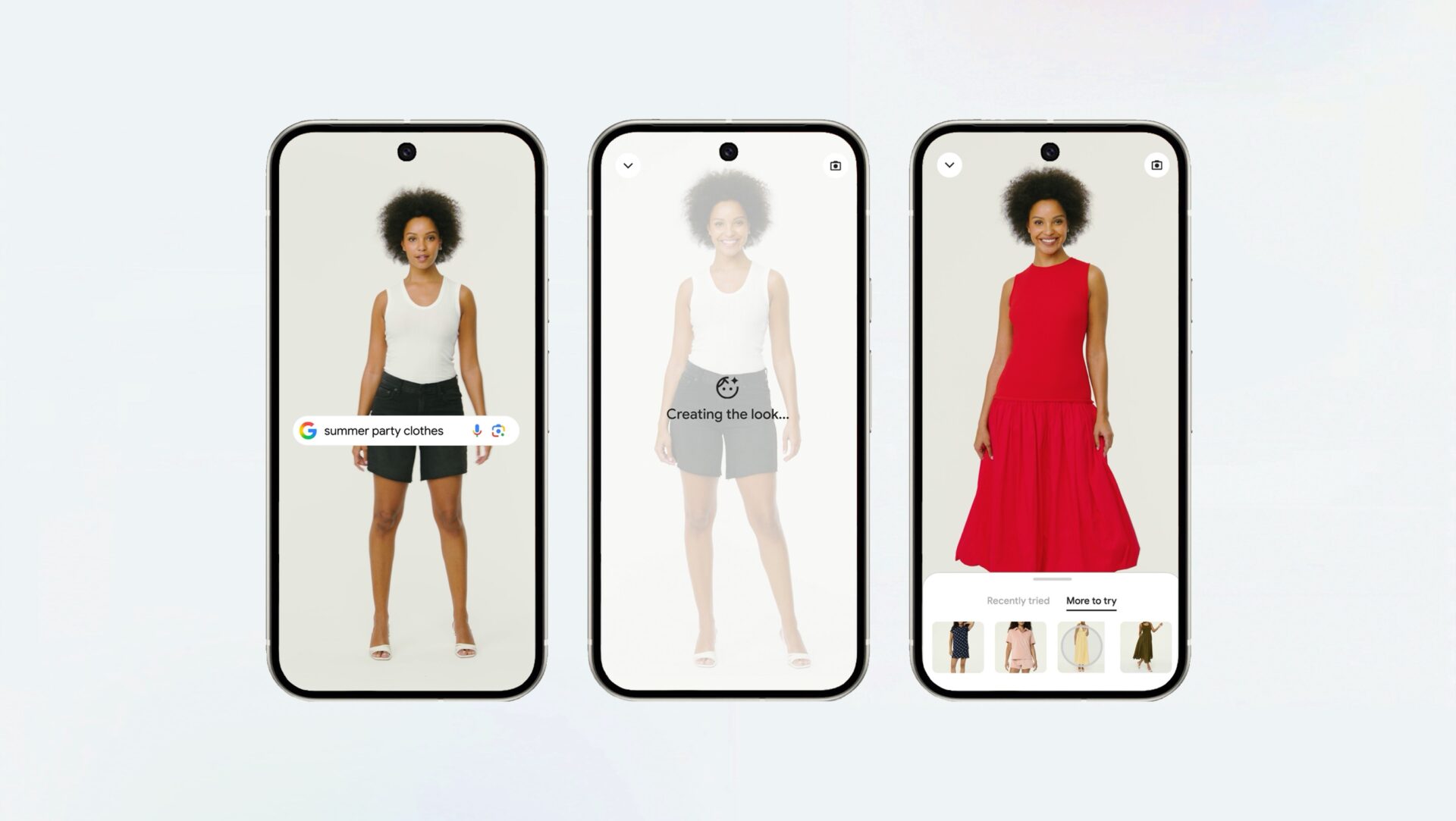
The internet giant’s vision for artificial intelligence is becoming increasingly tangible. From virtually trying on clothes before making a purchase to asking smart glasses to identify landmarks, translate conversations, or navigate city streets, the company is steadily weaving AI into everyday life.
The latest developments showcase how Google’s Gemini ecosystem is moving beyond the smartphone screen and into the physical world, changing not only how people shop, but also how they experience their surroundings.
Bringing The Fitting Room Online
One of Google’s newest consumer-facing features is its AI-powered “Try On” tool, which is gradually rolling out to Hong Kong. Online fashion shopping has long suffered from a simple problem: uncertainty. Product photos may look appealing on professional models, but translating that image onto your own body type often requires a leap of faith. Google’s virtual try-on feature aims to bridge that gap.
Users can upload a full-body photograph and instantly see how a garment might look on them. The system works across billions of apparel listings available through Google Search, Google Shopping and Google Images, allowing shoppers to experiment with different styles, colours and silhouettes without ever stepping into a changing room.
Unlike earlier virtual fitting tools that merely overlaid clothing onto a static image, Google’s custom image generation model is designed to understand how fabrics behave on different body types. It can simulate details such as draping, stretching and creasing, creating a more realistic representation of how an item may appear when worn.
The feature also extends to footwear, allowing users to visualise how sneakers, loafers or heels may complement an outfit before purchasing.
Users can save their favourite looks, compare different styles and share them with friends before being redirected to a retailer’s website to complete a purchase.
Gemini Moves Beyond The Smartphone
While AI-powered shopping may feel futuristic, Google’s ambitions extend much further.
At its recent Android XR showcase, Google demonstrated how Gemini could become the operating system for a new generation of smart glasses.
Activated with a simple voice command, Gemini can interpret what users are seeing in real time and provide contextual assistance. Walking through an unfamiliar neighbourhood, users could ask for restaurant reviews simply by looking at a storefront. Travellers could translate menus, street signs and conversations on the fly. Navigation becomes more intuitive as the glasses understand not only location data but also the direction the wearer is facing.
The glasses are also designed to handle everyday tasks. Users can send messages, answer calls, summarise missed notifications and interact with third-party apps through voice commands. Gemini can even perform multi-step actions in the background, such as preparing a food delivery order while the user’s phone remains in their pocket.
Photography receives an AI upgrade as well. Users can capture photos or videos with voice commands and use Google’s image-editing capabilities to remove distractions, modify backgrounds or create playful visual effects.
In many ways, the technology represents Google’s most ambitious attempt yet to make AI a constant companion rather than an occasional tool.
The Promise And Managing The Privacy Questions
Yet as AI moves closer to our eyes and ears, it also revives longstanding concerns about surveillance and privacy.
Google’s original Google Glass famously faced backlash more than a decade ago, with critics worried that people could be recorded without their knowledge. Today’s AI-enabled eyewear raises similar concerns, but with far more sophisticated capabilities. Because smart glasses incorporate cameras, microphones and real-time AI processing, bystanders may be unknowingly captured in photos, videos or voice recordings. Commentators have argued that recording indicators can be difficult to notice, particularly outdoors in bright daylight.
There are also broader questions surrounding cloud processing and data handling. When AI assistants analyse images, objects or conversations, that information may be transmitted to remote servers for processing. Industry-wide controversies involving AI systems have highlighted concerns that some user interactions could be reviewed by human contractors for training and quality-control purposes, potentially exposing sensitive information if safeguards are not robust enough. As long as consumers are aware, and can moderate this, there should be guardrails to prevent such issues from becoming a real cause of concern.
Finally, AI-powered eyewear introduces new concerns around biometric and spatial data. Devices capable of continuously interpreting a user’s environment may inadvertently capture financial information, confidential documents or the activities of people nearby.
Privacy advocates have also warned that combining smart glasses with facial recognition technologies could create new risks relating to surveillance, stalking and identity tracking. As these technologies become more mainstream, the challenge for companies like Google will be balancing convenience and innovation with meaningful transparency, consent and user control.