



At the tail end of the Singapore International Festival of Arts (SIFA), Lush Life arrives carrying decades of cultural memory. For many Singaporeans, Jacintha Abisheganaden and Dick Lee are not merely artists but creative emblems of a formative era in the arts scene, glamorous, ambitious, cosmopolitan, and intensely scrutinised as public figures. Lush Life remains emotionally compelling because it resists easy moral conclusions. Dick is neither monster nor martyr. Jacintha is neither casualty nor heroine.
Their 1992 marriage, at the height of both their careers, once fascinated pioneer generation Singaporeans, as much as their music did. Directed by Ong Keng Sen, the four-act production, with a short interval, revisits that memory without surrendering to nostalgia. It unfolds as something far stranger and more personal: a fragmented, melancholic portrait of a woman whose pursuit of music repeatedly collided with the demands of love, marriage and public expectation. What follows is less a linear biography than an accumulation of memories, songs, confessions and emotional fragments.
Creative Intimacy Between Two Singaporean Cultural Icons
Jacintha recalls her first marriage to lawyer David Scheffer as emotionally repressive as the narrative drifts through her time in Hawaii, and through the disco-era of Singapore. Layered with macrobiotic diets amidst the blissful landscapes of Waikiki beach, early artistic ambitions, and eventually the arrival of her second husband, Dick Lee, “husband material,” at least in theory.
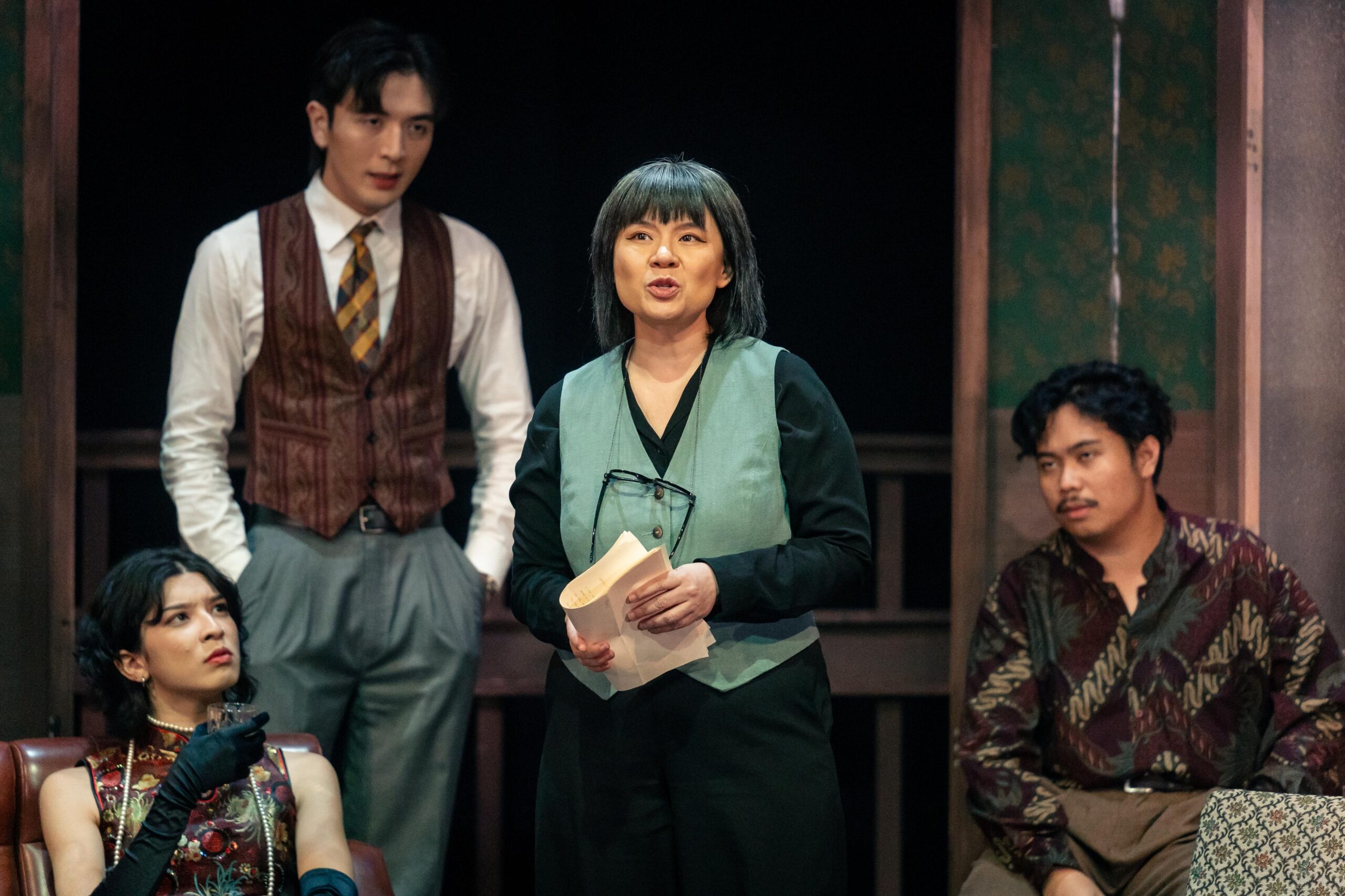
Their weekly Saturday rehearsals at 4pm become symbolic of a purer form of companionship, built around music rather than romance and the eventual domesticity. Through anecdotes about synthesizers, songwriting sessions and the emergence of Singapore’s English-language pop scene in the 1980s, Lush Life evokes a cultural moment when artistic possibility and collaboration, between two Singaporean cultural icons, itself felt intoxicating. The production’s strongest passages evoke the creative intimacy, narrated by Jacintha herself, whilst performed and cross-dubbed by what appears to be a ‘youthful’ version of herself, played by Frances Lee, that preceded the marriage.
By the time they married in 1992, both artists were at the height of their visibility. Lee’s wildly successful album “The Mad Chinaman” had turned him into a regional celebrity pursued by Japanese paparazzi, while Abisheganaden had been cementing herself as a jazz vocalist and theatre actress. Their union fascinated Singapore society and invited speculation. Ong wisely refuses definitive answers. As had been noted before the staging by broadsheet editors eager for the performance, that there are at least two truths, hers and his, and the production allows both versions to coexist uneasily onstage.
The staging of their Sentosa wedding at a lavish hotel, as Jacintha recounts, becomes one of the production’s most memorable sequences. Sampans run out of gas. Lanterns extinguish themselves prematurely. Relatives and wedding committees fuss endlessly over logistics, Peranakan ceremony and appearances. The wedding itself sounded produced, almost burdened by expectation before the marriage had even begun. Ong stages it as almost performative, elaborate, and, a looming sign that it were quietly doomed, with the benefit of hindsight by some of his friends, that had felt that they were incompatible. He did not see it that way. Dick Lee, a man swept away by love in that period, quietly emerges not as a villain but as someone fundamentally incapable of fulfilling the romantic fantasy Jacintha desired.
Pressured by familial expectations as the eldest son, and seemingly consumed by career obligations whilst getting increasingly famous abroad, he appears perpetually elsewhere. He obliges by being present at the “necessary dinners” leading up to the wedding, where the Internet was not yet a thing. He further admits that at the the height of his dizzying career, he were shuttling between Japan and Hong Kong, pursuing a Mandopop dream.
Jacintha, meanwhile, describes the first year of her marriage with Dick as “a whole rhythm of waiting”: through architectural meetings for their marital home, obligatory family rituals, and overseas concert tours where Dick were away at long stretches, while attempting to become the ideal daughter-in-law.
Marriage itself paradoxically created the distance and increased the expectations held by Jacintha, which were once well-disguised as an unshakeable bond, via close proximity for the former lovebirds due to their living arrangements. The production is at its best when it lingers in emotional erosion rather than dramatic confrontation. It were clear that Dick were at length, physically and emotionally absent from the marriage itself. With brief moments, punctuated by overseas calls from Dick, to Jacintha at her in-laws, she continued to wait for their marital home to be ready, whilst Dick were no where to be found.
There are no explosive revelations. Instead, intimacy slowly dissolves under the pressure of incompatible desires. Jacintha wanted a kind of artistic Romeo, as her dreams to pursuit her jazz singing career were quietly sidelined, during the period, leading to the eventual dissolution of their marriage in 1997. Whilst Dick wanted children, stability, perhaps even a Sound of Music-style domestic ideal. “Started as a common dream,” his reflection goes, “ended as sadness.”
Even the ending of the marriage, he recounted, arrived with devastating banality. After one stop on a shared concert tour too many, they separate almost wordlessly, after their fair share of disagreements on the production set, where there were ultimately a timely intervention by the touring crew. By then, due to the irreconcilable friction that arose, there were no grand farewell. No theatrical climax. Just two individuals, going their separate ways. Yet Lush Life is not ultimately about failed marriage.
Lifelong Pursuit of Music
Ong frames the entire production around Jacintha’s lifelong pursuit of music not simply as profession, but as identity and survival. The daughter of guitarist Alex Abisheganaden and arts educator Eileen Wong, she is portrayed as someone fundamentally restless, difficult to domesticate, driven by instinct rather than social expectation.
There is something untamed in Jacintha throughout the production. Not reckless, but irreducible. Seen this way, the marriages become less moral failures than collisions between artistic freedom and conventional ideas of womanhood, partnership and stability. The production’s final movement, dealing with Jacintha’s third husband, journalist Koh, darkens considerably, as she chased her dreams as a jazz performer, in the city of dreams, New York. She describes him as an “emotional Jack the Ripper”: whilst charming, came across as volatile, with known violent incidents, such as smashing objects around her. Fortunately, without physically striking her and her child.
Ong stages these recollections with restraint rather than sensationalism. The smashing of her treasured Peranakan mirror becomes more painful precisely because it stands in for accumulated emotional violence.
Throughout the evening, Frances Lee’s portrayal of Jacintha’s younger self adds another layer of poignancy. Her singing haunts the older Jacintha almost like memory itself — youthful possibility echoing across decades of compromise, heartbreak and reinvention.
Ong Keng Sen navigates this deftly, and understands that relationships often collapse not because of singular betrayals, but because two people inhabit entirely different emotional narratives while believing they are sharing the same dream. What lingers after Lush Life is not scandal or heartbreak, but melancholic recognition. The same artistic passion that draws people together can also make ordinary companionship impossible. Yet the production refuses bitterness.
In its closing moments, Jacintha still sings of the hope, of “chasing dreams” and “placing bets”, as though belief in life itself: in music, in love, in reinvention, remains necessary despite everything.
Featured Image: Lush Life by T:Works