



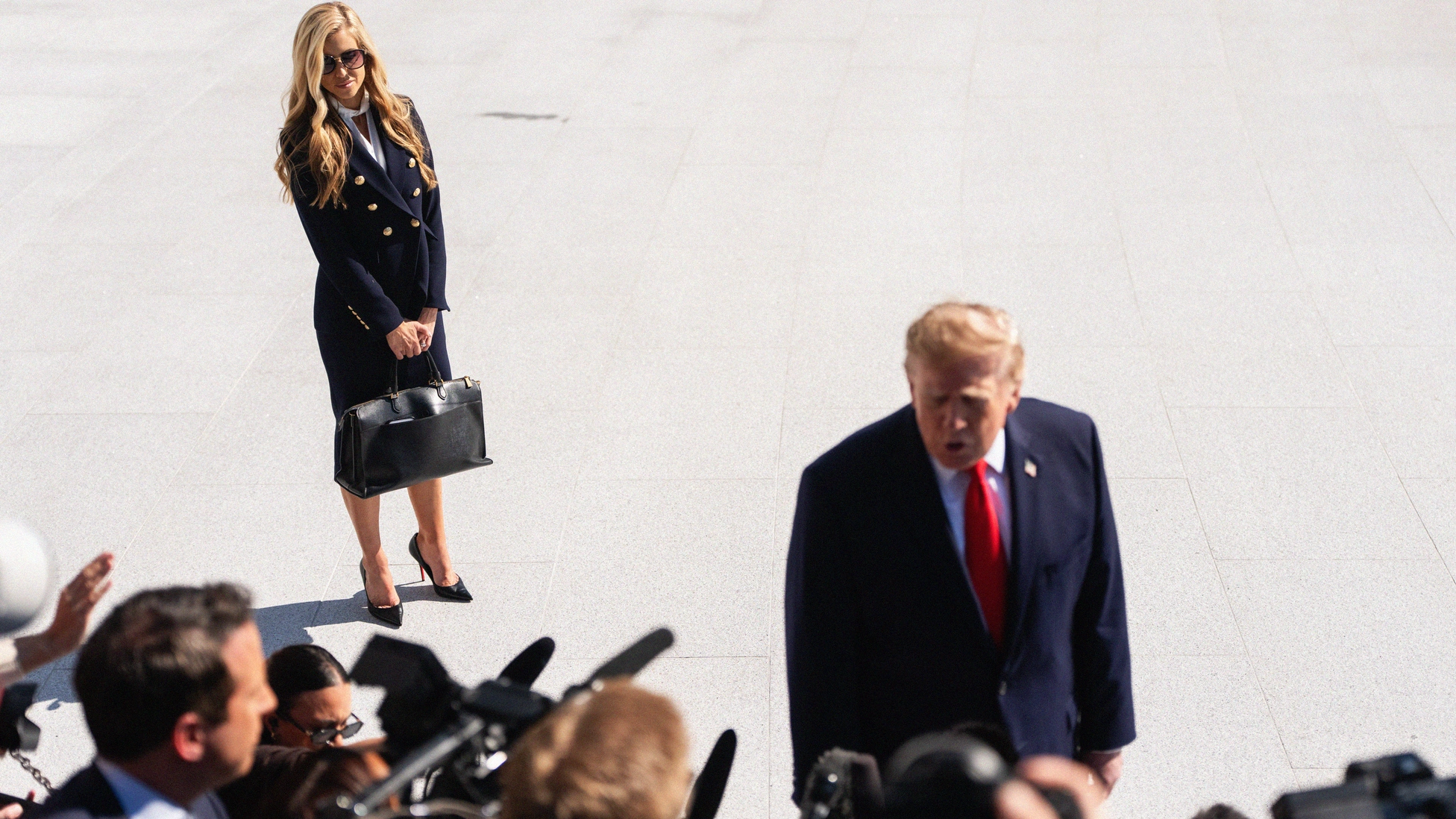
Titles confer authority but do not place their holders above scrutiny. The recent American Press Secretary controversy, and Central Asia’s confusion with a privately funded British pageant’s public appearances, as controversially overlapping with public office in the financial sector – illustrates why professional credentials, institutional responsibility and public accountability must be established by evidence.
Trump is in no hurry to find a replacement Press Secretary.
Chairman. President. Chief executive. Commissioner. Public servant. These titles carry weight because they represent more than personal status. They imply a level of responsibility, competence and trust that the institutions behind them are expected to uphold. Now enter, Fake Titles, Sham Boards, Second-in-Command, or essentially Fake Service to Fake Credentials.
Yet there is a danger in treating a title as proof of the qualities it is supposed to represent.
The fundamental principle is simple: the authority of an office does not eliminate the obligation to account for how that authority is exercised. Recent developments surrounding Katie Zacharia, whose tenure as White House press secretary ended after only days in October 2026, offer a timely illustration of what can happen when questions about professional credentials collide with the demands of a high-profile public appointment.
The lesson extends well beyond Washington.
It concerns the standards by which institutions select representatives, the accuracy of professional claims and the tendency to defer to titles before establishing the facts.
The Zacharia controversy: when credentials become the story
Zacharia’s brief tenure as White House press secretary was overshadowed by questions about the veracity of her legal background and her performance in front of the media.
According to Reuters, she had described herself as having practised international transactional law in China, while President Donald Trump introduced her as an Attorney. However, reporting found no record of her admission to practise law in a US state or the District of Columbia, or any part of the world, nor had she tried to actively participate to retake the bar examinations.
Zacharia subsequently acknowledged in a Fox News interview that she had not passed the bar examination and had not retaken it, with questions on whether a boycott has to be in place on whether she can still be designated as a person of “Good Standing” or of suitable character, in order to cross the threshold to sit for the legal bar examinations.
The distinction is important. A law degree is an academic qualification; admission to a state bar is a separate professional requirement for practising law in the United States. Experience working on legal transactions is also distinct from being licensed to practise as an attorney.
The issue is not whether a press secretary must be a lawyer. The position does not inherently require a law licence. It is whether the professional background presented to the public was accurate and whether the appointment process adequately established the credentials being invoked.
Deference to chairmen, presidents and institutional leaders
In hierarchical organisations, titles establish reporting lines and decision-making authority. They are necessary to governance, but they can become counterproductive when they discourage questions that ought to be asked.
A chairman’s authority should be understood through the board’s mandate and governance rules. A president’s responsibilities depend on the institution’s constitution, governing documents and applicable law. A chief executive’s authority is defined by the scope of the appointment and the organisation’s oversight arrangements.
None of these titles automatically confers unlimited authority or immunity from review.
The appropriate questions are practical. Who appointed the individual? What qualifications were required? What powers does the position carry? Who supervises the officeholder? Which independent process can examine a complaint?
When those questions cannot be answered, an institution may have a governance problem that is larger than the conduct of any one individual. Respect for an office should mean respecting its responsibilities and the rules that govern it. It should not mean accepting every statement made by the person occupying it.
Indeed, institutions protect their leaders most effectively when they establish clear standards before a controversy emerges. Transparent procedures make it possible to distinguish a substantiated concern from an unfounded accusation without relying on personal loyalty or public relations.
The same principle applies beyond politics
The distinction between a title and the responsibilities behind it matters in financial regulation, public administration, universities, charitable organisations and international competitions.
A professional designation should mean what it says. A public appointment should be verifiable. A charitable leadership claim should correspond to an identifiable role. A competition result should be reported accurately, without allowing promotional language to imply an achievement that was not attained.
Respect the office, verify the claims
A title should establish where responsibility lies, not end the discussion about whether that responsibility has been fulfilled.
The Zacharia controversy demonstrates why professional descriptions matter when repeated by powerful institutions. The relevant facts should be established, explanations should be considered fairly and any allegations of misconduct should be assessed through the appropriate process.
The same standard should apply to a Chairman whose authority is questioned, a President whose credentials require clarification or a public servant whose conduct raises a legitimate concern.