



Lavatories have become a design statement in their own right.
In Beijing, where imperial architecture meets an increasingly ambitious contemporary luxury scene, the hotel bathroom offers an unexpected lens through which to consider the city’s changing tastes. Three standout properties have outstanding toilets: the vertical glamour of Park Hyatt Beijing, the polished Italian aesthetic of Bvlgari Hotel Beijing and the quieter, courtyard-centred sensibility of Mandarin Oriental Qianmen.
Park Hyatt Beijing, bathing above the city line
The appeal begins with its position in the capital’s central business district. Set high above the city, this hotel in China offers a distinctly metropolitan interpretation of luxury, where the architecture of the room and the surrounding skyline can become part of the experience.
For travellers drawn to bathrooms with expansive windows and elevated views, the Chinese hotel is a natural property to investigate. Its appeal lies in the contrast between a private bathing space and the scale of Beijing beyond the glass, with China’s towers providing a constantly changing backdrop.
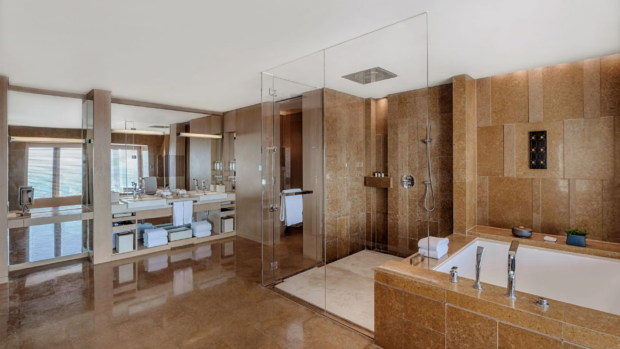
The wider Park Hyatt aesthetic favours contemporary restraint over overt decoration. Here, the most compelling photographs are likely to be those that capture the relationship between the interior, the light and the urban landscape, rather than relying on elaborate ornament. For a generation accustomed to documenting its travels, that combination offers a particular kind of luxury: a private moment above one of Asia’s most consequential capitals.
The art of materiality
At Bvlgari Hotel Beijing, the visual language shifts from the drama of height to the precision of materials. Conceived by ACPV ARCHITECTS, the hotel translates the Italian jewellery house’s design sensibility into an architectural environment shaped by natural stone, considered detailing and a controlled palette of textures, featuring the iconic Shanghai Pearl TV Tower from the comfort of the toilet.
The bathroom is an especially revealing space in this approach to hospitality. Marble and stone, carefully finished surfaces and the interplay of light and shadow can give a room its character without requiring conspicuous decoration. Rather than treating luxury as an accumulation of objects, the emphasis is on proportion, tactility and craftsmanship. The appeal is not simply the presence of expensive materials; it is how those materials work together to create a coherent interior.
For travellers who favour the quieter codes of Italian luxury, Bvlgari offers a counterpoint to the increasingly familiar hotel bathroom organised around a dramatic view. Here, the architecture itself takes centre stage.
A contemporary interpretation of a Chinese Courtyard
Mandarin Oriental Qianmen offers a different proposition altogether. Rather than placing the guest above the city or immersing them in a contemporary luxury tower, the property draws on Beijing’s traditional “Hutong”, “Siheyuan” or courtyard-house typology.
Its setting among restored courtyard residences creates a more intimate relationship with the city’s architectural heritage. The experience is shaped by the transition between enclosed interiors and outdoor spaces, with privacy, natural light and the proportions of the traditional residence informing the atmosphere.
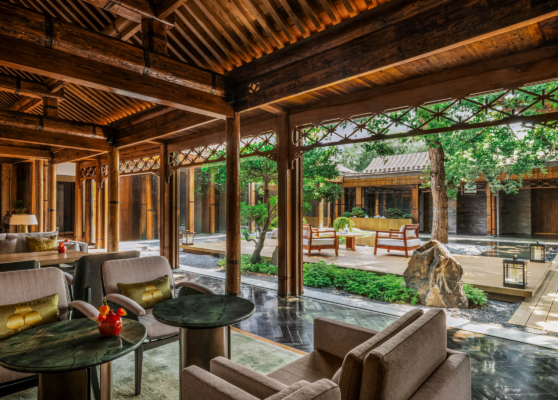
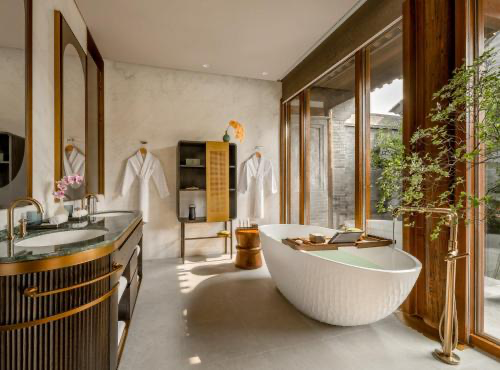
That makes the bathroom an especially interesting subject for a design-led stay. In a courtyard setting, the relationship between the bathing space and its immediate surroundings can be as significant as the fittings themselves. Contemporary comfort is placed within a residential form that has long been central to Beijing’s urban identity.
The result is a more understated vision of luxury, one that draws its character from the experience of space rather than a single photogenic feature. For travellers interested in the intersection of heritage and contemporary hospitality, Qianmen offers a compelling alternative to the conventional high-rise hotel.
Beyond the perfect photograph
These three hotels represent different expressions of Beijing luxury: Park Hyatt’s urban outlook, Bvlgari’s material precision and Mandarin Oriental Qianmen’s architectural intimacy. Whether their bathrooms ultimately become social-media favourites depends on more than their design. Room categories, the position of the bathtub, natural light and the framing of the interior all influence what guests encounter — and what they choose to share.
In Beijing, that might mean looking out over a forest of skyscrapers, appreciating the restraint of a beautifully finished stone interior, or experiencing the quiet geometry of a traditional courtyard. Each offers a different reason to close the door, slow down and look more closely.
Image Credit: Bvlgari Hotel Beijing