


At the 61st Venice Biennale, national pavilions continue to act as both cultural statements and spatial experiments, each one distilling how countries choose to present themselves on one of art’s most scrutinised global stages.
This year, three presentations stand out not only for their artistic ambition, but for what they signal about presence, return, and reinvention: Japan’s participatory installation, Morocco’s debut at the Arsenale, and India’s reappearance after a seven-year hiatus.
Japan: Play, Care, and Participation
At the Japanese Pavilion, queer artist, Ei Arakawa-Nash, who has renounced his Japanese citizenship, transforms the exhibition space into something closer to a living system of care than a conventional display. In Grass Babies, Moon Babies (2026), visitors encounter more than 100 baby dolls, ready to be adopted, inspired by his personal fathering of twins, whose identities, and gender are undisclosed, as a controversial, politically loaded statement, against the conservative backdrop of Japan’s LGBT laws, where same-sex marriages are disallowed.
Each, are with distinct personalities, birthdays, and even poems generated through interaction.
Some dolls sit expectantly on tables, others rest in landscaped corners of the pavilion or hang from sculptural structures. Visitors are invited to pick them up, carry them through the space, and engage in acts of caretaking before completing a final ritual: changing a diaper and scanning a QR code to receive a short poem.
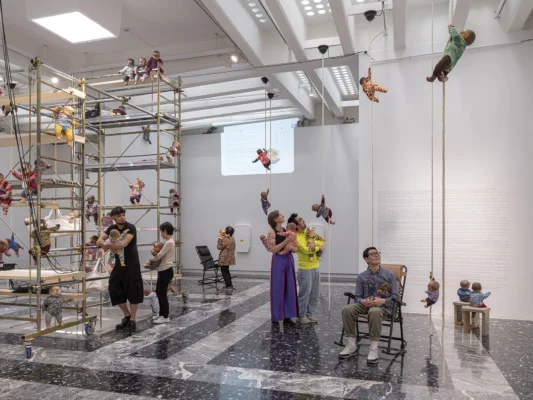
Inspired in part by Arakawa-Nash’s experience as a parent to twins, the work reframes the pavilion as a temporary community of shared responsibility—part performance, part social experiment, part game.
Morocco: Weaving as Architecture and Memory
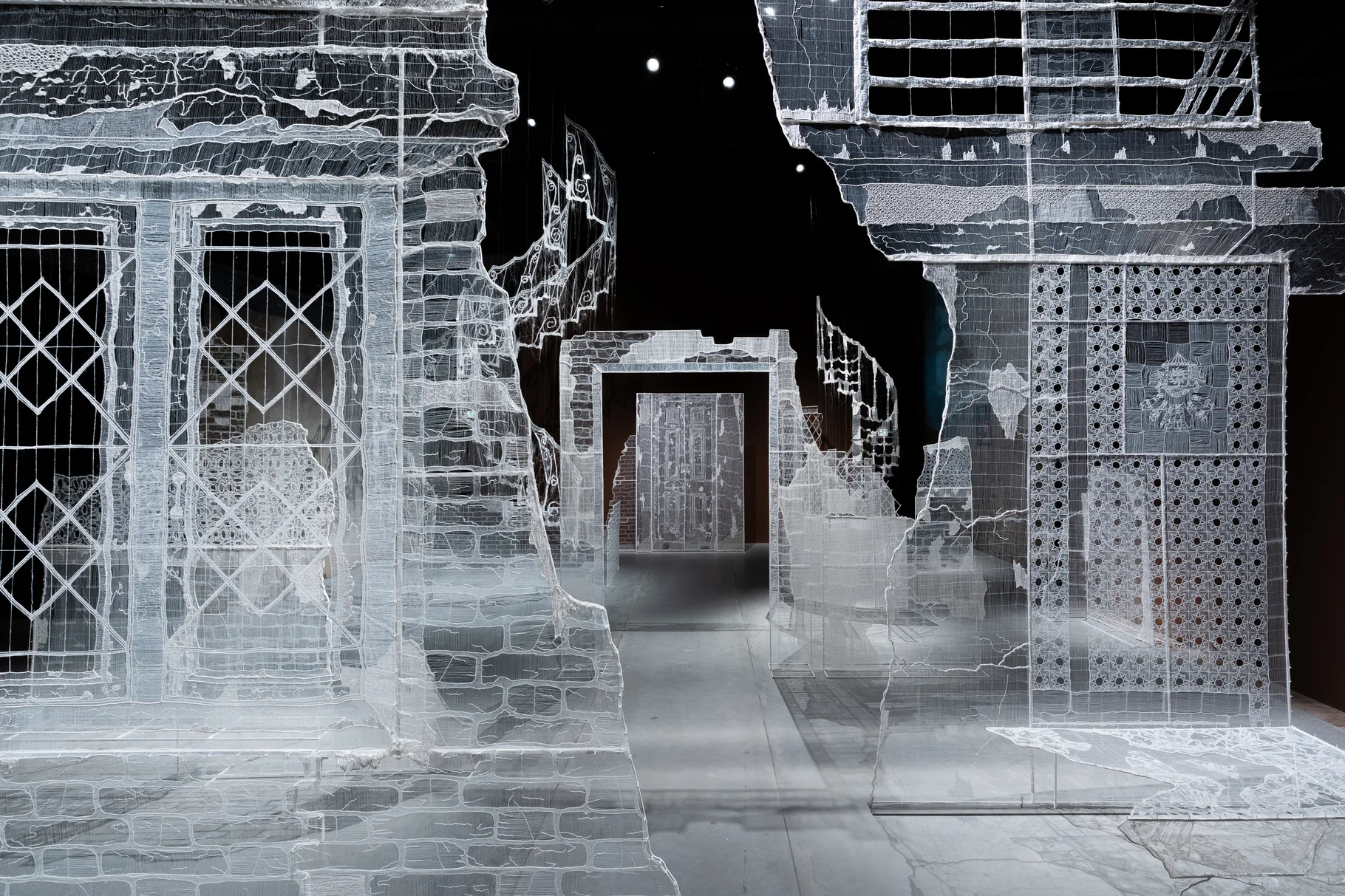
Morocco’s first pavilion at the Arsenale marks a significant moment of institutional presence, led by artist Amina Agueznay with the large-scale installation Asǝṭṭa (2026).
Rooted in Amazigh weaving traditions, the work brings together 166 artisans from across Morocco, whose collective labour spans weaving, embroidery, basketry, and jewellery-making. Over six months, their techniques are translated into an immersive environment of suspended textiles and layered surfaces.
Rather than presenting craft as static heritage, Agueznay positions it as a living system of exchange. The installation’s woven forms wrap the gallery and spill from the ceiling, blending Moroccan geometric traditions with subtle Venetian references—Murano glass, water-like reflections, and cartographic abstractions of the lagoon city.
Personal and generational memory is embedded throughout, including protective “eye” motifs dedicated to the artist’s mother, the Moroccan artist Malika Agueznay. The result is both architectural and intimate: a space where textile becomes structure, and tradition becomes process.
India: A Return to the Venice Biennale
India’s reappearance after seven years signals another kind of shift: not only in artistic direction, but in cultural visibility within the Biennale framework. While details of the pavilion programme continue to draw attention, its return itself is being read as part of a broader recalibration of India’s presence on the international art stage.
Across these three pavilions, a shared thread emerges: participation. Whether through care, collaboration, or re-engagement after absence, each presentation reframes what it means to inhabit a national pavilion today—not as a fixed statement, but as a space of negotiation, labour, and lived experience.
An Extension of the Venice Biennale 2026 Central Asia Preamble

Across painting, installation, and digital media, the artists examine themes of tradition and modernity, human and nonhuman relationships, migration, and ecological memory. Their works range from contemporary reinterpretations of traditional Mongolian Zurag painting to multimedia projects rooted in mythology, natural materials, and Central Asian landscapes.

The exhibition takes place at Squero Castello, a former shipyard whose history as a hub of maritime circulation mirrors the exhibition’s focus on connectivity. By situating the pavilion within this historically layered space, the project turns the venue itself into a metaphor for cultural exchange.
Rather than emphasising a singular national identity, Entanglements: Connectivities Across Borders proposes a more networked curatorial model—bringing together Mongolian institutions, European curators, and a Korean regional arts organisation. In doing so, it reflects the broader spirit of the Biennale’s theme “In Minor Keys,” conceived by late artistic director Koyo Kouoh, foregrounding subtle connections and shared cultural currents over grand national narratives.
Featured Image: India Pavilion for Venice Biennale 2026