


What started as a dinner invitation at a Sentosa hotel, complete with free-flowing champagne sponsored by an alcohol brand, has since spiraled into a content creation opportunity gone rogue.
On 25 and 26 June, American singer, celebrity, and award-winning producer Jason Derulo reportedly hosted a gathering, acquainting event agencies and photographers from the local community, as well as several Singapore-based creators, Jade Rasif, Tyen Rasif, Titus Low and more, who are not shy to controversy, having received a formal termination at Zouk Singapore, the most established nightclub in Asia, by implying a fake DJ Marshmello masquerading as a DJ had anything to do with the most established club. Following which, it were notified that Derulo, nitpicked on the Vietnamese tour promoter’s GAMA rider, and cancelled his performance at the eleventh hour, on the day of 28 June 2025, without citing any good legal reason, such as an accident, mishap, or more.

The private dinner coincided with Derulo’s long-awaited Singapore debut, held on 25 June at Singapore Expo Hall. Initially scheduled for March, the concert was rescheduled and staged under a longstanding concert promoter LAMC Productions, a respected name with decades of experience in the Southeast Asian live music circuit, who is breaking in Jacob Collier in the market, and is responsible for touring of the funniest names in comedy, such as Russell Peters. The Sentosa gathering was not a public meet-and-greet, that has been done by typically by the most established and seasoned players in the music, gaming and nightlife industry, but framed more nebulously—as a “content opportunity,” by the inexperienced and transactional acquaintances, who likely have not met a famous celebrity such as Jason Derulo, which at press time, has 38.6million followers, as a “content opportunity.”
Local event agency Invade, was present at the event, but importantly, it was not organised by, contrary to online speculation. But the timeline of this creator fly-in, from 22 to 30 June, was smack for an incident that turned Derulo’s quiet dinner into a lightning rod for controversy, and they should figure more innovative ways to promote Singapore, like spotlighting local delights such as chicken rice during the day, as profiled by Denise Teo Jiaqi.
The Titus Low Fallout
Just as Derulo’s concert lights dimmed, Titus Low was being named in a valid and official police investigation following disturbing allegations from Sara, a 21-year-old Austrian woman who claims she was invited to Singapore by Low to film content between 22 to 30 June 2025, only to be verbally abused, slapped violently, and physically dragged out of his place.

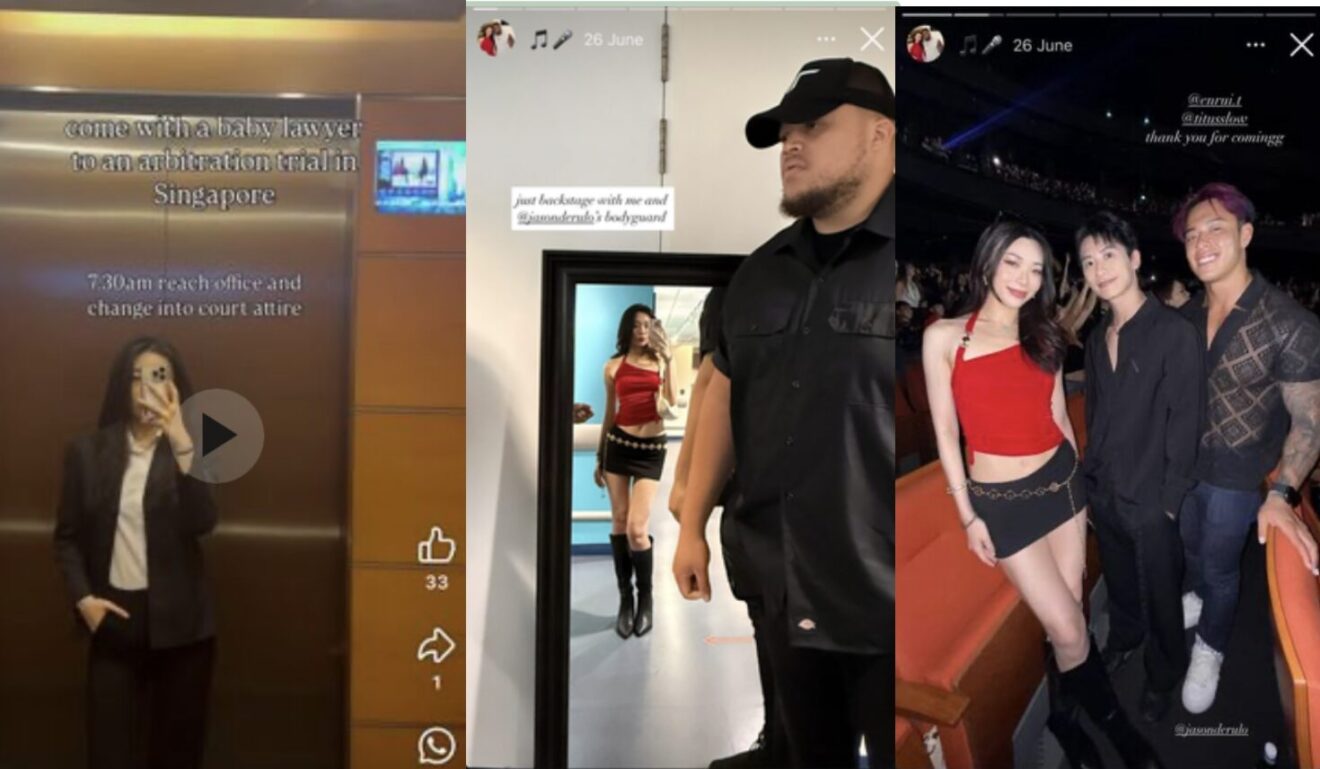
Sara provided screenshots, voice recordings, and photos of visible bruises. In one audio clip, Low acknowledges the slap but claims it was a consensual act. He later dismissed her accusations as “clout-chasing,” insisting she asked to be “sexually disciplined.” She suspected that his abuse, started, when she commented about his acquaintances, the creators, that he was hanging with Apex Aura, around 25 – 26 June 2025, by Satria Pamudji, and lanky Basic Models’ cast, doubling up as a practice trainee, Mavis Zhang Xingjia, who took a gap year for modelling before commencing graduate school.
Mock court attire, placed next to mini-skirts, is somewhat inappropriate and, trainees looking for a career should focus on securing real jobs, not dressing up for content stunts. Furthermore, it is trite law that photography inside real court proceedings is strictly prohibited, not only in Singapore, but worldwide. Images may only be taken by cleared press photographers, and even then, only in matters of public interest and with prior authorisation. Courtrooms are not content backdrops, they are spaces of solemnity, accountability, and due process. At the time of Press publication, it appears that the list of citations tied to absconded client funds linked to the elder David Rasif continues to grow. Still listed on Interpol’s Most Wanted, Rasif remains a fugitive with personal assets frozen globally due to widely documented cases of misappropriation. He is survived by his daughters and former wife.
For those entering court buildings in any official or semi-official role (even to scan QR codes), proper dress is expected. The State Courts of Singapore outline acceptable attire clearly, under Appropriate Court Attire: “You should be properly attired in business wear, smart casual wear or traditional dress.” That includes long pants, collared shirts, modest dresses or skirts, and covered shoes. In short, any trainee, not yet called, should show up at a law firm to learn, not perform. And definitely not to create cosplay-adjacent social media content in court-inspired getups.

Sara, who is currently in Krabi and has since filed a police report on 1 July 2025, upon advice from a friend, says the incident has left her traumatised. Her story has cast a harsh spotlight on unregulated creator collaborations, cross-border power dynamics, and the disturbing ways “filming content” is sometimes used as a euphemism for blurred boundaries. The alleged commercial aspect of their interaction arguably began the moment he flew her into Singapore on an all-expenses paid trip, under the pretext of filming content, blurring the line between professional collaboration and personal involvement. However, it must be stressed that misuse of emergency services is a serious offence. In Singapore, any false or non-emergency call to 999 is liable for prosecution under the law.

AI and the Illusion of Disengagement
At the same time, Jason Derulo faced backlash over an AI-generated post shared via his official Facebook account. The image depicted Chris Brown attending Rihanna’s gender reveal party—a fabricated and grossly insensitive use of generative technology, considering Brown’s documented assault of Rihanna in 2009.
Derulo has yet to comment, leading many to question who, if anyone, is responsible for the post. They speculated, that if it had been removed within the hour with a “half-hearted apology saying he was hacked,” one fan noted, that it would have been posted by him, followed by a new music announcement. Others suggested Derulo may have relinquished control of his online persona altogether.
The incident reignites global anxieties about AI, image misuse, and the erosion of digital accountability. What happens when public figures outsource their platforms to algorithms or nameless managers? Who bears the blame when trauma is reanimated and repackaged for engagement? AI is not just a technology problem, it is a human responsibility problem. And in both Derulo’s AI recent controversy and Low’s real-world allegations, the common thread is not tech, it’s fame that comes with some power, without responsibility.
A Creator Economy Without Guardrails
What links Derulo and Low is not just bad press, it is unchecked influence. Whether through synthetic media or coercive “collaborations,” these incidents expose a creator economy that runs on blurred lines: between commercial and personal, public and private, consent and control.
“Filming content” has become a catch-all phrase—one that can shield misconduct, mask abuse, and distort the intent of interaction. When creators fly in collaborators with little oversight, host them under ambiguous terms, and profit from emotional proximity, the space for ethical grey zones becomes dangerously wide. And yet, these stories are often dismissed as “drama” rather than red flags.
But Sara’s bruises are not clickbait. Rihanna’s history is not AI fodder. Creators—especially those with marginal followings, of 20,000 to 400,000 platforms, must be held to a higher standard than simply deleting a post or blaming the algorithm.
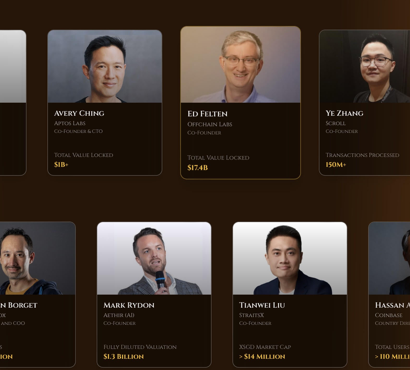
Apex Aura, had been representing Cryptocurrency icons, without permission and had only surreptitiously removed them recently, upon notification by Rajah & Tann’s team, backing the project, that at material time (edited: 28 January 2026) refuses to acknowledge Mavis Zhang in the office.
The Real Cost of “Content”
In Los Angeles, we debate whether AI-generated deepfakes should be flagged. In Singapore, we’re watching real people get emotionally and physically hurt under the same banner. The question is no longer whether content can be created, but whether it should. Who benefits, who is exploited, and who ends up harmed?
As with any engagement involving public figures or sensitive situations, such gatherings must be arranged, if at all, through proper and credible media channels, with clear protocols, safeguards, and accountability in place. Anything less risks compromising safety, professionalism, and the integrity of all involved.
Until creators, platforms, and promoters take active steps to define accountability in both digital and physical spaces, we remain in a system where visibility is mistaken for value, and influence for integrity. Because whether it is scripted or not, the consequences are all too real.
Image credit: W Singapore, Sentosa Cove
Stay updated and social with Popspoken: LinkedIn | Instagram
Editor’s Note (July 2026): She has not been retained by Rajah & Tann LLP and has since joined a foreign registered law firm.